
Data Center Map

Co-location? Colocation? Collocation?


By on June 11, 2009

When reviewing company submissions here at Data Center Map, I often stumble upon the many different ways of spelling colocation. Data center is often spelled in different ways as well, but that is normally due to local grammar - so what is up with colocation? It kind of ignored me to constantly meet those three different ways of spelling it, so I decided to look in to whether one of the terms was more correct than the others.

The most obvious is to start out by googling to see which term is most widely used. To ensure it was primarily related to data centers, I did searches with “data center”, “data centre”, “datacenter” and “hosting” in them.
The combined results looked like this:

colocation: 1.814.000 results
co-location: 1.498.000 results
collocation: 179.000 results

So to continue I wanted to check what was most widely used in the media via Google News, which gave the following results for the past month:

colocation: 320 results
co-location: 255 results
collocation: 198 results

Next I thought I would look at what the industry leaders call the service:

Equinix: colocation
Interxion: colocation
Switch & Data: colocation
TelecityGroup: colocation
Telehouse: colocation
Terremark: colocation
Savvis: colocation

So now that we have the large providers and the media included, I thought it might be worth including what people were buzzing about on blogs via Google Blog Search:

colocation: 201.000 results
collocation: 46.000 results
co-location: 29.000 results

And last but not least, I compared the three terms via Google Trends to see what people was searching for:
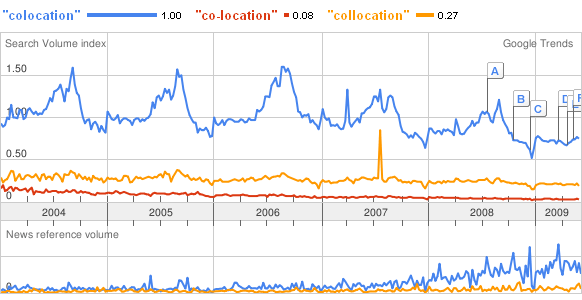
Colocation trends via Google Trends

Looking at the Data Center Map statistics, it is also very clear that we receive more visitors searching for colocation than co-location, even though we have been spelling it as “co-location” until this research was done.

Judging from the numbers the conclusion is pretty clear, that colocation is definitely the most widely used term and therefore the best term to be using if you want to reach the majority of your target group. Of course there can be some countries, regions etc. where one of the other terms (or other words) are more widely used so keep that in mind as well.

Be aware that the words can of course also be used in relations that has absolutely nothing to do with our industry, so the numbers aren’t 100% correct.

June 11, 2009
13 Comments
Related posts
13 Comments on Co-location? Colocation? Collocation?

Respond | Trackback

  1. Mike says:

    I mostly see it spelled colocation or co-location.

  2. Kevin Hazard says:

    Microsoft Word’s default spelling is collocation … and even as I write the word colocation in this blog comment, my browser tells me it’s spelled wrong and offers “collocation, coloration, co location, co-location and echolocation” as potential “correct” spellings.

  3. Art Cancro says:

    “collocation” is obviously incorrect. Where does the second L come from? Someone spelled it wrong at some point, and it stuck. Colocation or co-location are obviously correct.

  4. Alternatively the second L comes from another language where the word is just spelled differently, and then it somehow has spread to other countries and international use.

  5. Tom says:

    I think colocation is correct.

    for example

    http://colocationserver.org/Colocated-Hosting.html

    Regards
    Tom

  6. Alex says:

    Thank you, Sune! Excellent work! I wasn’t sure which spelling I should use on my resume, but your article erased any doubts: it’s colocation all the way!

    Funny, the browser spell checker still thinks this spelling is incorrect, but Word 2010 no longer minds :)

  7. Uli says:

    Oh noes, someone is wrong on teh internets! ;)

    @Art, @Sune: Nope, “collocation” is not obviously incorrect. Indeed, “collocate” and “collocation” are much much older than “colocate” and “colocation” and have different roots. See e.g. here: http://www.noslangues-ourlanguages.gc.ca/bien-well/fra-eng/orthographe-spelling/colocaliser-collocate-eng.html

  8. Jeff Kuerzi says:

    Would someone tell Microsoft this so that spell check would quit recommending collocation?

  9. Ryan says:

    Collocation is the original word going back to a Latin root. Colocation is a construct that originated in the 60’s as co-location but eventually lost the hyphen as most words did (e.g., to-day and to-morrow.) Both have the same general meaning, but the tech usage uses the one invented in its industry rather than the older military one.

  10. Branden says:

    Now if we could just figure out whether to use datacenter or data center; and fiber channel or fibre channel!

  11. Scott says:

    Co-location is correct. Colocation is incorrect. A simple way to remember it is that a hyphen is used if the word is not in the dictionary and colocation is not in the dictionary (well, not in good dictionaries like Oxford English). Collocation refers to a grouping of words, or to placing things side by side or particular arrangements, but isn’t specifically about equipment and it is a stretch to use the word in a way to refer to a co-location. To co-locate means to share a premises or location. Collocation was incorrectly used by the FCC when they defined a co-location arrangement, and subsequently the lawyers all decided to use the word collocation, rather than fight an uphill battle for correct grammar.

  12. Paul J. A. says:

    Here are some important points to consider:

    First, the spelling of words, especially recently coined words, is not static. A word may not appear in one dictionary, but appear in another, or a later edition may add a word or alternate spelling.

    Second, words with hyphens tend to lose their hyphens after a period of common use, so it’s perfectly natural for a word to begin as co-location, then become colocation after the passage of time. Consider how “E-mail” became “e-mail,” then “email.”

    Finally, the different spellings may well indicate different usages, and in fact may indicate different “words” entirely. “Collocation” is by far the most common spelling when referring specifically to the linguistic concept of words which occur together with greater than random frequency. Common phrases such as “turn down” are examples of lexical collocations. This is quite different from the concept of “colocation” relating to business, which appears to be the focus of this page, and which is probably a much more recently coined term.

Respond

Comments

Comments: